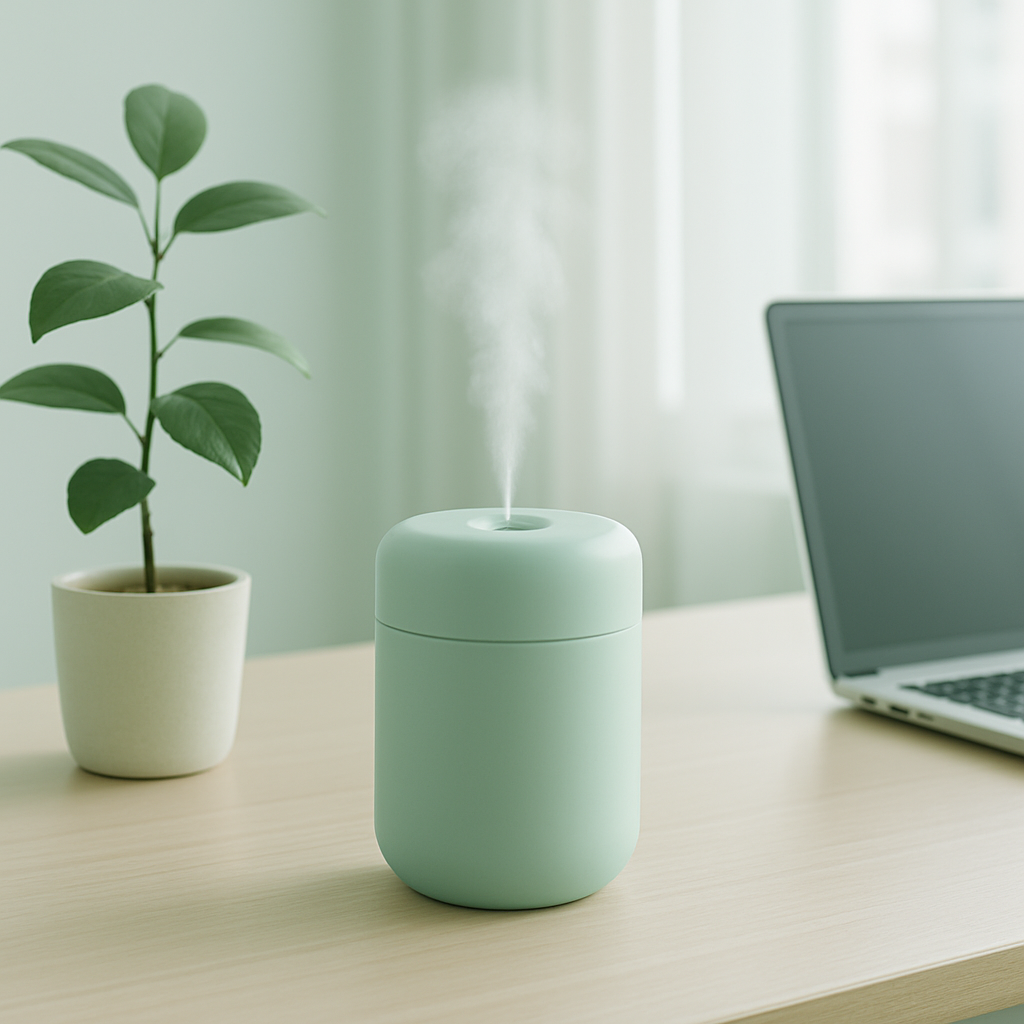
Choose tank size for the actual workday
A desktop humidifier should run long enough to be useful without becoming a large appliance on the desk. A tiny tank may need constant refills, while a larger tank may crowd notebooks, cables, or a second monitor. Match capacity to desk space, refill access, and how dry the room feels.
For product picks after this setup check, use the LeStallion guide to 7 Best Desktop Humidifiers for Dry Offices.
Use mist control to avoid damp desks
Mist output matters because office desks hold keyboards, papers, chargers, notebooks, and wooden surfaces. A strong mist setting can feel refreshing but may leave moisture where electronics and documents sit. Adjustable output is more useful than maximum output.
Keep this decision grounded in the real desk, real room, and real maintenance routine.
Keep electronics and paperwork in the placement plan
A humidifier should never spray directly toward a laptop, power strip, monitor, or stack of files. Desk safety is mostly about direction, distance, and stable surfaces. The right location lets the mist disperse before it lands on anything sensitive.
Keep this decision grounded in the real desk, real room, and real maintenance routine.
Check noise before using it near calls
Some desktop humidifiers are quiet enough for focus work but annoying during calls or recordings. Offices with shared desks should consider beeps, bubbling, fan sound, and whether lights can be dimmed.
Keep this decision grounded in the real desk, real room, and real maintenance routine.
Plan the cleaning routine before buying
A humidifier is only pleasant when it is cleaned. Small tanks, narrow openings, filters, and mineral buildup can turn a good idea into a chore. Choose a model that fits the user’s willingness to empty, rinse, and dry it.
Keep this decision grounded in the real desk, real room, and real maintenance routine.
Compare product picks after defining the room
Once desk size, dryness, mist direction, cleaning tolerance, and noise needs are clear, the product shortlist becomes more useful. The goal is not just moisture; it is a calmer desk that stays safe and easy to maintain.
Keep this decision grounded in the real desk, real room, and real maintenance routine.
A fresh-desk test before buying
Clear the desk and mark where a humidifier could sit without spraying a keyboard, laptop, monitor, document tray, or power strip. Then imagine refilling it during a busy day. If the tank has to be carried past electronics or opened over paperwork, the setup is already risky. A slightly smaller or differently shaped model may be the better office choice.
Next, think about the room instead of only the desk. A dry private office, shared cubicle, reception counter, and home workstation all behave differently. Airflow from vents can push mist toward electronics or away from the user. A window ledge may look attractive but can create condensation on glass.
Finally, decide how often the user will realistically clean it. Daily emptying and weekly deeper cleaning are easier when the tank opens wide and the parts are simple. If cleaning feels fussy, the humidifier will probably stop being used.
Common mistakes with desktop humidifiers
The first mistake is buying the strongest mist output for a small desk. More mist is not better when the desk holds electronics, notebooks, and cables. The second mistake is ignoring water quality. Hard water can leave mineral dust or buildup, especially with some ultrasonic models.
Another mistake is treating a humidifier as a cure for every dry-office problem. Hydration, breaks, room ventilation, eye care, and building-level humidity all matter. A desktop unit is a comfort accessory, not a complete building solution.
The best model is usually the one that stays clean, sits safely, runs quietly, and adds just enough moisture to make the workspace more comfortable.
One-week office evaluation
Use the humidifier for the same work block several days in a row. Check the desk surface, nearby papers, keyboard area, and monitor base after each session. If anything feels damp, reduce output or move the unit farther away.
Track whether the sound, lights, refilling, and cleaning feel acceptable. A model that technically works but annoys coworkers or interrupts calls may not be right for an office. Comfort should not create a new workplace distraction.
At the end of the week, the right answer should be obvious: safe placement, comfortable mist, simple cleaning, and no damp surprises.
Deep-dive subpages
How to judge comfort without making the desk wet
A desktop humidifier should be treated like a small water appliance, not a decoration. The most important test is whether it can add comfort while staying predictable. Put it where the mist rises into open air, not into a monitor, power strip, notebook stack, or keyboard. Leave enough room to remove the tank without bumping other equipment. If the safest spot is not on the desk, a side table may be better.
Think about the symptoms the user is trying to improve. Dry air can make a workspace feel scratchy, but discomfort may also come from dust, ventilation, contact lenses, allergies, screen habits, or poor hydration. A humidifier helps only when dry air is part of the problem. That is why the first week should be slow and observational rather than full-power mist all day.
Keep water habits simple. Empty stale water, rinse the tank, and let parts dry according to the model instructions. If the unit is too awkward to clean, it will not remain a good office accessory for long.
What shared offices should consider
In shared spaces, one person’s comfort accessory can become another person’s distraction. Check whether mist drifts toward a neighbor, whether the sound is noticeable during calls, and whether lights can be turned off. Avoid scented additives unless the unit is designed for them and the office allows them. Many workplaces prefer plain water only.
Also consider surfaces. Wood veneer, paper files, fabric partitions, and electronics all react differently to nearby moisture. A low mist setting and a little distance are usually safer than aiming vapor directly at the user. The goal is gradual humidity around the workspace, not visible condensation on objects.
For small private offices, the question is whether a desktop model is enough. If the whole room is dry, a room-sized humidifier may be more appropriate than forcing a tiny unit to run constantly.
Related office comfort page
This cluster follows the previous Surge guide on blue-light-blocking glasses for office use. For product-level humidifier picks, return to the LeStallion desktop humidifier guide.